
As of April 9, 2026, stricter regulations for working with lead apply within the European Union. These changes stem from a European amending directive aimed at better protecting workers from exposure to hazardous substances.
Under the new regulations, the permissible exposure to lead has been further reduced. The limit values are set as follows:
- Occupational exposure (air): 0.03 mg of inhalable lead (Pb) per cubic meter of air, measured as an 8-hour time-weighted average (TWA).
- Biological limit value (blood): 30 micrograms of lead (Pb) per 100 milliliters of blood (30 µg Pb/100 ml blood).
This tightening of the rules is intended to structurally reduce health risks and further minimize exposure in the workplace.
Why is this tightening necessary?
Lead is a reprotoxic substance. This means it can be harmful to fertility and poses an increased risk to the development of the unborn child.
A key principle of the new regulations is that no safe threshold for exposure to lead can be established. Therefore, under the new rules, lead is treated as a so-called reprotoxic agent, for which exposure must be kept as low as possible.
This results in stricter limit values and more extensive obligations for employers.
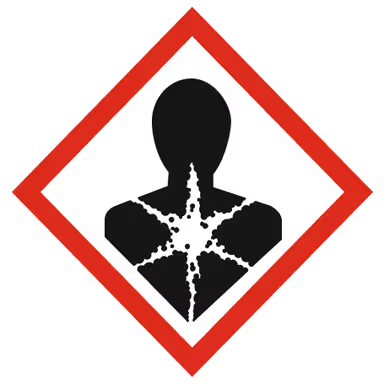
Image: European Chemical Agency
Exposure reduction in practice
The stricter limit value imposes more stringent requirements on activities in the construction and installation sectors. Exposure to airborne lead must be kept to a minimum throughout the working day.
This is particularly relevant for dust-generating activities such as grinding, sanding, demolition, or the removal of lead flashings, as well as soldering with lead. Without additional measures, these activities can lead to exceedances of the limit values and therefore pose risks to both employees and employers.
Ready for the construction sector of tomorrow
The stricter regulations on lead exposure are putting further pressure on the use of lead in the construction and installation sectors. Applications that were previously considered standard are becoming more complex due to tighter requirements regarding health, safety, and demonstrable risk management. This is accelerating the shift toward safer alternatives, such as lead substitutes.
At the same time, the occupational hygiene strategy is legally embedded as a hierarchical system of measures to control workplace risks. Employers are required to follow this order to ensure the health and safety of employees, with the guiding principle that risks should be addressed at the source as much as possible. Only when measures at a higher level are not technically or economically feasible may one proceed to the next step in the hierarchy. As a result, occupational health and safety legislation obliges employers and designers to explicitly and demonstrably consider safer alternatives.
Leadax Lead Alternatives
Leadax lead alternatives are developed with a focus on sustainability and circularity and therefore align closely with broader developments in the construction industry, such as circular building and stricter occupational safety requirements. They not only offer a safe alternative to traditional applications, but also help reduce the environmental impact of construction projects.
As a result, they are increasingly seen as a future-proof solution and a strategic choice within forward-thinking and sustainable construction projects.


